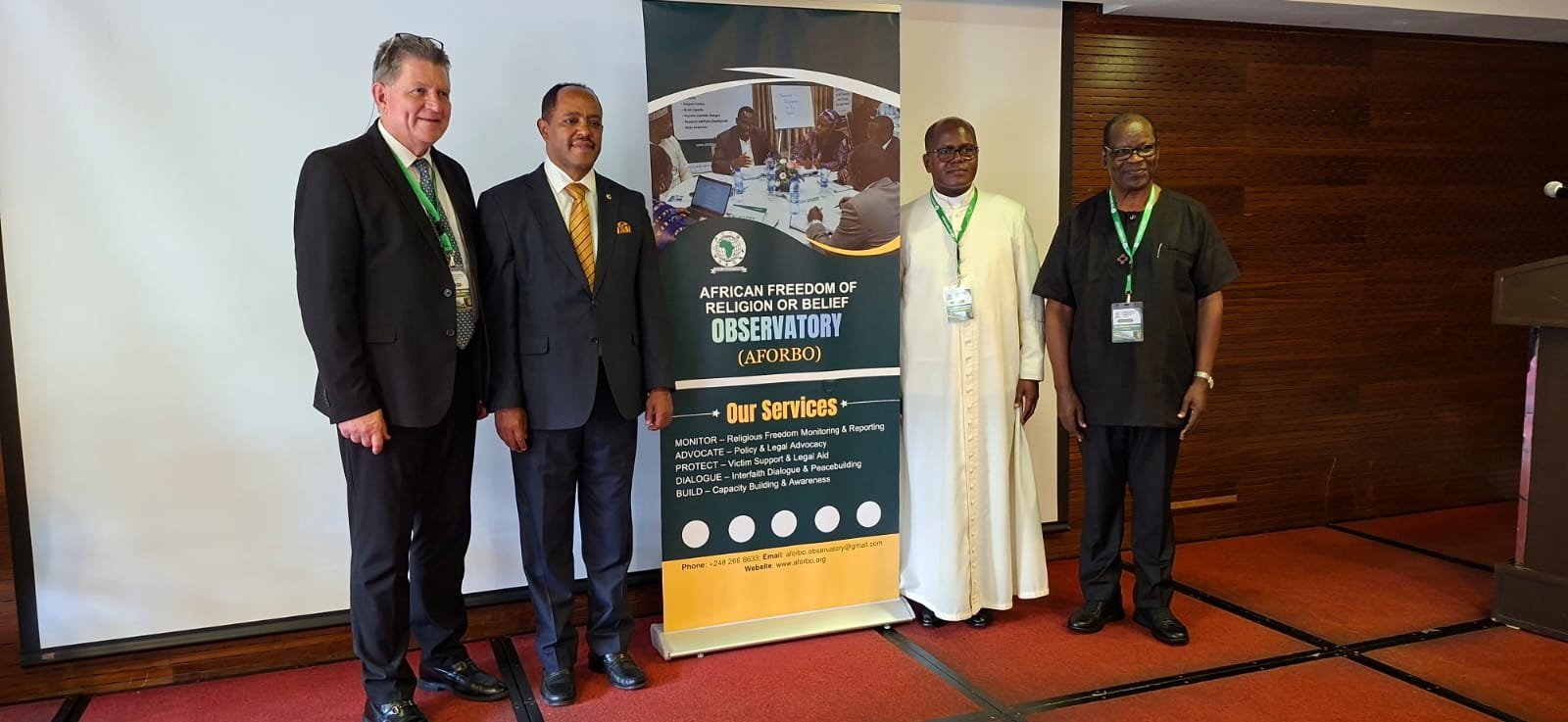
Welcoming Remarks by Fr. Dr. Louison Emerick Bissila Mbila, during the launching ceremony of the African Freedom of Religion or Belief Observatory (AFORBO), Mahé, Seychelles, 28 October 2026
Your Excellencies,
Ladies and Gentlemen,
Dear Peacemakers,
Welcome to Paradise Seychelles!
Ex Africa semper aliquid novi (“Out of Africa there is always something new”). This saying, traditionally attributed to Pliny the Elder, aptly summarises our endeavour today: the official launch, on Seychellois soil, of the African Observatory for Freedom of Religion or Belief (AFORBO).
The defence and promotion of religious freedom are, of course, not new concepts. Tertullian of Carthage, in the early third century AD, already employed the phrase libertatem religionis (“religious freedom”) and became its ardent advocate. His influence extended to Lactantius, who, in turn, decisively impacted Emperor Constantine. Together, Constantine and his Eastern counterpart, Licinius, made the solemn and courageous decision through the Edict of Milan in 313 AD to grant religious freedom to Christians, who had long endured imperial persecution. After centuries of the history of religious freedom, marked by both enlightenment and darkness, one might ask: is there truly anything new under the sun?
Yes, there is something new under heaven. For the living and true God is the God of newness, who continually fills us with wonder beyond all understanding: “Ecce nova facio omnia” — “Behold, I make all things new” (Revelation 21:5). Today, sons and daughters of our continent agree that the defence and promotion of the fundamental human right of freedom of religion or belief must primarily become the concern of Africans themselves. We must train our own observers and, with impartiality and credibility, articulate what is truly happening across our continent regarding freedom of religion or belief.
Today, 28 October 2026, sixty-one years to the day since the promulgation of the Second Vatican Council’s Declaration Nostra Aetate on the relationship of the Church to humanity’s other religious traditions, we gather to shape our future. For the aspirations of the African Union’s Agenda 2063, “The Africa We Want”, to become reality, peace must prevail globally and within Africa. As the late Swiss theologian Hans Küng famously stated: “No peace among the nations without peace among the religions. No peace among the religions without dialogue between the religions.” Today, we must add: no peace among the religions and no dialogue among the religions without religious freedom.
During this day marking the Observatory’s official launch, we will have the opportunity to reflect on religious freedom and its extensive scope, which far exceeds mere freedom of worship. We will hear representatives from various religious, spiritual, and ethical traditions share their perspectives on this fundamental human right. Above all, in a spirit of dialogue, we will discuss the way forward for freedom of religion or belief.
In this room are people who have travelled from the United States, Italy, Mali, South Africa, Kenya, Côte d’Ivoire, and Ethiopia — in short, from various corners of the world — joining their brothers and sisters living in Seychelles to sow the seed of an observatory for freedom of religion or belief in Africa. To borrow a biblical image, Seychelles is called to be, and to remain, that great tree grown from the mustard seed, sheltering the birds of the air in its branches and offering shade to travellers on the road to religious liberty and freedom of belief.
We extend our gratitude to Ambassador Conrad Mederic, who, during his remarkable and widely recognised mission in Addis Ababa, generously embraced this project and brought it to the attention of the Ministry of Foreign Affairs and of Diaspora of Seychelles. We are particularly grateful to the Minister for Foreign Affairs and the Diaspora, Ambassador Barry Faure, for his swift action in securing the Observatory’s recognition and accreditation in Seychelles. Above all, our gratitude goes to His Excellency Dr. Patrick Herminie, President of the Republic of Seychelles, who rightly perceived that by agreeing to the Observatory’s foundation in Seychelles, this beautiful, God-blessed archipelago can itself become a powerful message of peace for Africa and for the world. We raise our hands and hearts to Heaven, imploring the Most High to grant him robust health and the vision he needs to become a true champion of freedom of religion or belief in Africa, the Continent of Hope.
On this blessed day, adapting the traditional saying, we may also declare: “Out of the Seychelles there is always something new.” It is not a country’s size that matters, but its readiness to serve noble and higher values. By agreeing to host the Observatory — of this we are certain — every time the defence of religious freedom spares a life in the many parts of our continent scarred by violence in the name of religion, history will remember that the Seychelles played its part.
In closing, I would like to quote Pope Saint John Paul II, who dedicated his Message for the World Day of Peace on 1 January 1988 to the theme “Religious Freedom, Condition for Peace”: “The world needs peace; the world longs for peace. Let us pray that all men and women, enjoying religious freedom, may live in peace.”
God bless AFORBO. God bless Seychelles. God bless Africa.
Thank you.